


“This park is for the scientist and the lover of nature. Here the student may read the story of the earth’s creation, and the lover of nature may find many a lovely spot…“
Benjamin Franklin Loomis

Imagine a landscape where boiling mud pots and hissing steam vents carve out a dramatic, otherworldly scene, just a short walk from the tranquil, deep blue waters of an alpine lake. This is the world of contrasts you will find at Lassen Volcanic National Park. This remarkable corner of northeastern California is a living, breathing geology lesson, a place where the violent, creative forces of our planet are on full display. It is a land shaped by fire, sculpted by ice, and bursting with life.
Long before it was a national park, this land was a sacred and important place for several Native American tribes, including the Atsugewi, Yana, Yahi, and Maidu, who considered Lassen Peak a point of origin and a place of great power. The first widely recorded European-American discovery of the area’s main hydrothermal features came in 1865, when pioneer Kendall V. Bumpass stumbled upon a boiling, sulfuric basin. In a now famous story, he stepped through the thin crust, severely burning his leg and giving the area its memorable name: Bumpass Hell.
However, it was a cataclysmic event that truly put Lassen on the national map. Between 1914 and 1915, Lassen Peak awakened in a spectacular series of eruptions, culminating in a massive explosion that sent a mushroom cloud of ash seven miles into the sky. A local photographer, Benjamin Franklin Loomis, meticulously documented the eruptions. His stunning photographs and tireless advocacy convinced the federal government to protect this unique landscape. On August 9, 1916, President Woodrow Wilson signed the legislation that officially established Lassen Volcanic National Park, preserving its wonders for all future generations.


How to Get To Lassen Volcanic National Park
Navigating to the Land of Volcanoes
Lassen Volcanic National Park is located in a relatively remote part of northeastern California, but it is accessible from several major cities. The main road through the park, California Highway 89, connects the northwest and southwest entrances. Be aware that this road is typically closed from November to May or June due to heavy snowfall. Always check the park’s official website for current road conditions before you travel.
From Susanville, take Highway 36 West for approximately 50 miles to reach the Southwest Entrance of the park.
From Redding, CA (The Closest City):
Redding is the primary gateway to the park. The drive takes about one hour.
To the Northwest Entrance (Manzanita Lake Area): From Redding, take Highway 44 East for approximately 48 miles directly to the park entrance.
To the Southwest Entrance (Kohm Yah-mah-nee Visitor Center): From Redding, take Highway 44 East for about 20 miles. Turn right onto Highway 36 East in the town of Mineral and continue for 10 miles to the park entrance.
From Southern California (Los Angeles / Santa Clarita Area):
This is a longer drive, averaging around 8 to 9 hours without major stops.
Take Interstate 5 (I-5) North for approximately 460 miles to Redding.
Once in Redding, follow the directions above to either the Northwest or Southwest entrance via Highway 44.
From the San Francisco Bay Area:
The drive from San Francisco is typically 4 to 5 hours.
Take Interstate 80 (I-80) East toward Sacramento.
Just before Sacramento, take Interstate 505 (I-505) North to connect with Interstate 5 (I-5) North.
Continue on I-5 North to Redding, and then follow the directions from Redding to the park entrance of your choice.
From Reno, NV:
The drive from Reno offers a scenic approach from the east and takes about 2.5 to 3 hours.
Take U.S. Route 395 North into California to the town of Susanville.

Hiking in Lassen Volcanic National Park
Exploring Lassen’s Diverse Trails
Lassen’s trail system offers an incredible variety of experiences, from easy lakeside strolls to strenuous volcanic ascents. Every path provides a different perspective on the park’s dynamic geology and resilient ecosystems. Remember to carry water, sun protection, and be prepared for rapidly changing weather conditions at high altitudes.
Lassen’s trail system offers an incredible variety of experiences, from easy lakeside strolls to strenuous volcanic ascents. Every path provides a different perspective on the park’s dynamic geology and resilient ecosystems. Remember to carry water, sun protection, and be prepared for rapidly changing weather conditions at high altitudes.
Lassen Peak
- Difficulty: Strenuous
- Trail Length: 5 miles round trip
- Notable Features: This is the park’s signature hike. The trail climbs steadily over 2,000 feet to the 10,457-foot summit of the world’s largest plug dome volcano. The path is well-graded but exposed and at high altitude. Your reward is an unparalleled 360-degree panoramic view of the park, the surrounding Cascade mountains, and the distant Sacramento Valley. On a clear day, you can even see Mount Shasta to the north.
Bumpass Hell Trail
- Difficulty: Easy to Moderate
- Trail Length: 3 miles round trip
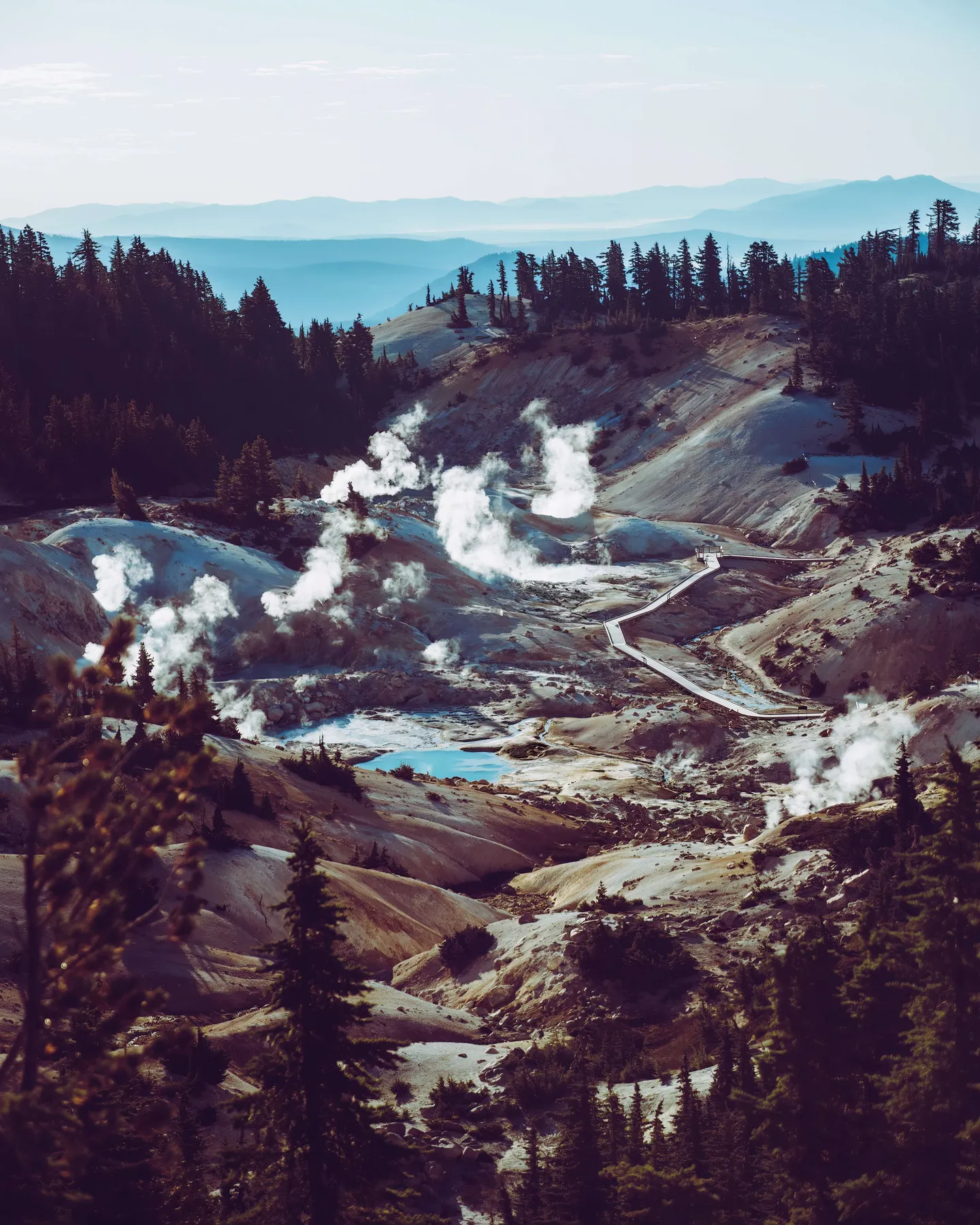
- Notable Features: This is your ticket to the park’s most impressive hydrothermal basin. After a pleasant hike with views of forested valleys, you will descend onto a boardwalk that winds through a landscape of bubbling mud pots, roaring fumaroles (steam vents), and vibrant mineral-stained ground. The smell of sulfur is strong, but the sight of the Big Boiler, a super-heated steam vent, is an unforgettable display of the volcano’s power.
Manzanita Lake Loop
- Difficulty: Easy
- Trail Length: 1.9-mile loop
- Notable Features: A perfect family-friendly hike or a relaxing evening stroll. This mostly flat trail circles the placid Manzanita Lake, offering postcard-perfect views of Lassen Peak reflected in the crystal-clear water. It is one of the best spots for photography, especially at sunrise or sunset. The area is also excellent for bird watching and spotting deer.
Cinder Cone
- Difficulty: Strenuous
- Trail Length: 4 miles round trip
- Notable Features: Located in the more remote northeast corner of the park, this hike feels like stepping onto another planet. The trail crosses a bed of volcanic ash before reaching the base of a near-perfectly symmetrical volcano. The final 700-foot ascent is a serious workout on loose, steep cinders, but the view from the crater rim is spectacular. You can see the multi-colored Painted Dunes and the vast Fantastic Lava Beds, created during the same eruption that formed the cone.
Kings Creek Falls
- Difficulty: Moderate
- Trail Length: 2.3-mile loop
- Notable Features: This trail showcases a different side of Lassen’s beauty. It descends gently through a beautiful forest and open meadows alongside Kings Creek, culminating at an overlook of the stunning 30-foot Kings Creek Falls as it thunders into a deep, rocky gorge. For the more adventurous, a steep stone staircase leads to the base of the falls, offering a cooler, mist-filled perspective.

Lodging and Camping Options in Lassen Volcanic National Park
Campgrounds, Cabins, and Lodges
While Lassen is more remote than some national parks, there are several excellent options for spending the night both inside the park and in nearby communities. Reservations, especially for camping, are highly recommended and can often be booked months in advance.
- Inside the Park
- Manzanita Lake Campground: The park’s largest and most popular campground, located near the Northwest Entrance. It offers sites for tents and RVs, a camp store, restrooms with flush toilets, showers, and kayak rentals on the lake. It’s an ideal base camp for exploring the northern part of the park.
- Summit Lake Campground: Situated more centrally along the main park highway, this campground is a great launching point for hikes like Kings Creek Falls. It has sites for tents and small RVs. The atmosphere is more rustic than Manzanita Lake.
- Butte Lake Campground: Tucked away in the remote northeast corner near Cinder Cone, this campground offers a more primitive and quiet experience for tent campers seeking solitude.
- Drakesbad Guest Ranch: The only hotel-style lodging within park boundaries. Located in the beautiful Warner Valley, this historic ranch offers lodge rooms, cabins, a dining hall, and access to a thermal-fed swimming pool. It’s a unique and peaceful retreat. Distance: Located in a remote southern valley within the park.
- Near the Park
- Lassen Mineral Lodge (Mineral, CA): A classic mountain lodge offering simple hotel rooms, a restaurant, and a general store. It is the closest full-service lodging to the park’s Southwest Entrance. Distance: Approximately 9 miles from the Southwest Entrance.
- Lodging in Shingletown, CA: This small town provides several options, including motels, inns, and vacation rentals. It’s a convenient base for accessing the park’s Northwest Entrance. Distance: Approximately 15 miles from the Northwest Entrance.
Top Things to Do in Lassen Volcanic National Park
Beyond the Trails: More Lassen Adventures
While hiking is a premier activity at Lassen, the park offers many other ways to connect with its unique landscape. Whether you are looking for relaxation, education, or adventure, there is something more to discover.
- Go Stargazing: Designated as an International Dark Sky Park, Lassen offers some of the most brilliant night skies in California. The park’s remote location and high elevation mean minimal light pollution, providing a stunning canvas for the Milky Way, meteor showers, and constellations. The park often hosts a Dark Sky Festival in the summer with special ranger programs and guest speakers.
- Kayak or Paddle on a Volcanic Lake: The calm, clear water of Manzanita Lake is perfect for kayaking, canoeing, or stand-up paddleboarding. Paddling across the lake offers a serene experience and an unparalleled view of Lassen Peak rising dramatically from the shore. You can bring your own equipment or rent kayaks at the Manzanita Lake Camper Store.
- Drive the Scenic Park Highway: The 30-mile Lassen Volcanic National Park Highway (California Highway 89) is an attraction in itself. The road guides you on a journey from lush forests up to the breathtaking, windswept heights of the volcano. Numerous pullouts provide incredible vistas and interpretive signs that explain the geology right in front of you. The highest point on the road is at 8,512 feet, offering a perspective you typically only get from a strenuous hike.
- Attend a Ranger Program: The National Park Service offers a variety of free programs designed to deepen your understanding of Lassen. Check the schedule for guided nature walks, talks about geology and wildlife at the Kohm Yah-mah-nee Visitor Center, and evening programs at the Manzanita Lake amphitheater. For younger visitors, the Junior Ranger program is an engaging way to learn about and protect the park.
- Visit the Kohm Yah-mah-nee Visitor Center: Located near the Southwest Entrance, this beautiful visitor center is the perfect place to start your visit. Explore the exhibit hall to learn about the four types of volcanoes found in the park, watch the park film to see footage of the 1915 eruption, and browse the gift shop. It is open year-round (though with limited winter hours).
Weather in Lassen Volcanic National Park
What to Expect: Weather by the Season
Weather in Lassen Volcanic National Park is defined by high elevation and can change very quickly. A sunny day can turn into a cold, stormy afternoon in minutes. Always dress in layers and carry gear for a range of conditions, regardless of the forecast.
- Summer (July to early September): This is the most popular and accessible season. Days are typically warm and sunny with daytime temperatures ranging from 70°F to 85°F (21-29°C). However, temperatures drop significantly at night, often into the 40s°F (4-9°C), so a warm jacket is essential for evenings. Afternoon thunderstorms are common and can build rapidly, bringing lightning, hail, and a sudden drop in temperature. All park roads and trails are usually open.
- Autumn (mid-September to October): Autumn can be a beautiful time to visit with fewer crowds and a touch of fall color from aspens and willows. Expect mild days with highs in the 50s and 60s°F (10-20°C), but be prepared for cold nights where temperatures regularly fall below freezing. The chance of a snowstorm increases as the season progresses, and the main park highway can close for the winter anytime from mid-October onward.
- Winter (November to April): Winter transforms Lassen into a quiet, snow-covered wonderland. The park receives immense amounts of snow, with an average snowpack of up to 30 feet at higher elevations. Daytime temperatures often hover near or below freezing (32°F / 0°C). The main park highway is closed to through traffic, but the areas around Manzanita Lake and the Southwest Entrance remain accessible for incredible snowshoeing and cross-country skiing opportunities.
- Spring (May to June): Spring is a season of dramatic transition. As the snow melts, waterfalls rage and wildflowers begin to appear at lower elevations. However, much of the park, including the high-country trails, remains buried in deep snow well into June. The park’s road crew works tirelessly to plow the 30-mile highway, which typically opens in sections throughout May and June. Weather is highly unpredictable, with conditions ranging from warm and sunny to cold and snowy. Always check for current road and trail conditions before visiting in the spring.
Wildlife to see in Lassen Volcanic National Park
Lassen’s Wild Inhabitants
Lassen is home to a diverse array of animals adapted to its range of elevations and habitats. Patient and quiet observation, especially during the early morning and late evening, will increase your chances of a memorable sighting. Remember to always keep a safe distance from wildlife and store food securely in bear-proof containers.
Mammals:
- American Black Bear: Lassen has a healthy population of black bears. They can be seen in forested areas and meadows throughout the park. While seeing one is a thrill, it’s critical to be bear-aware by properly storing all scented items and never feeding them.
- Mule Deer: These are the most commonly seen large mammals in the park. Look for them grazing in meadows at dawn and dusk, especially around Manzanita Lake and the Warner Valley.
- American Pika: Listen for the high-pitched “eep!” of this tiny relative of the rabbit in the high-elevation rock piles (talus slopes). The rocky terrain along the Lassen Peak trail is a prime habitat for these charismatic creatures.
Birds:
- Clark’s Nutcracker: You will likely hear this noisy, intelligent bird before you see it. They are common in the high-elevation forests, particularly near the whitebark pines around the Lassen Peak area.
- Steller’s Jay: This striking blue and black bird is a bold and common sight in the park’s coniferous forests.
- Waterfowl: The park’s many lakes, including Manzanita, Butte, and Summit Lakes, attract various species of ducks, geese, and other water birds. Ospreys can sometimes be seen fishing in these lakes.
Best Places to Take Photos in Lassen Volcanic National Park
Capturing the Perfect Shot: Photography Hotspots
Lassen’s dramatic landscapes offer endless opportunities for stunning photography. The best light is almost always during the “golden hours” of early morning and late evening, but amazing shots are possible throughout the day.
- Manzanita Lake at Sunrise or Sunset: This is the quintessential Lassen photograph. The calm waters of the lake create a perfect mirror, reflecting a spectacular view of Lassen Peak. The warm light of sunrise and sunset paints the peak in hues of pink and orange.
- The View from Lassen Peak Summit: For breathtaking panoramic landscapes, nothing beats the top of the peak. The 360-degree view allows you to capture the vastness of the park and the surrounding mountain ranges. Morning offers clearer air, while sunset provides dramatic light if you are prepared to hike down in twilight.
- Bumpass Hell Hydrothermal Basin: To capture the otherworldly nature of this area, visit in the cool air of the early morning when the steam from the fumaroles is most visible. The low-angle light enhances the texture and vibrant colors of the mineral-stained earth.
- Lake Helen: In the bright sun of midday, Lake Helen’s water takes on an almost impossibly deep, sapphire blue color. Frame your shot with the lingering snowfields and the slopes of Lassen Peak in the background for a powerful image of fire and ice.
- The Painted Dunes from Cinder Cone: After climbing Cinder Cone, you are rewarded with a view of this unique volcanic feature. The multi-hued dunes, stained by oxidized volcanic ash, are best photographed in the mid-morning or late-afternoon light, which creates shadows that define their shape and color.
- Astrophotography at a Pullout: As a Dark Sky Park, Lassen is a premier destination for night photography. Drive to a high-elevation pullout along the park highway, away from the light of any campgrounds. On a clear, moonless night, you can capture stunning images of the Milky Way arching over the volcanic peaks.
Things to Do Near Lassen Volcanic National Park
Exploring the Region: Attractions Near Lassen
The wilderness and wonder are not confined to the park’s boundaries. The surrounding region offers several worthy destinations to extend your trip.
- McArthur-Burney Falls Memorial State Park: Located about a 1.5-hour drive northwest of Lassen, this park is home to the magnificent Burney Falls. The 129-foot waterfall is famous for its power and unique beauty, with water emerging not just from the top but also from springs in the rock face. It is a must-see if you are in the area.
- Lake Almanor: This large, beautiful reservoir located south of the park is a popular spot for summer recreation. You can enjoy boating, swimming, fishing, and find numerous dining and lodging options in the lakeside town of Chester.
- Subway Cave: Just a short drive north of the park’s Manzanita Lake entrance, you can explore a fascinating lava tube. A self-guided, 1/3-mile trail leads you through the dark, cool cave. Bring a flashlight and a jacket, as the cave is dark and stays around 46°F (8°C) year-round.
- Hat Creek Rim Overlook: For one of the most expansive views in Northern California, stop at this overlook along Highway 44 between Lassen and Redding. On a clear day, the viewpoint offers a stunning panorama that includes the Lassen Volcanic area and the majestic, snow-capped cone of Mount Shasta to the north.
- Redding and the Sundial Bridge: If you are traveling through Redding, make time to visit the Sundial Bridge. This visually striking glass-decked pedestrian bridge was designed by world-renowned architect Santiago Calatrava and spans the Sacramento River. It is the centerpiece of the Turtle Bay Exploration Park, which also includes a museum and botanical gardens.
Wrapping Up Lassen Volcanic National Park
Lassen Volcanic National Park is a land of incredible contrasts. It is where the raw, violent power of a volcano meets the serene beauty of an alpine meadow. In a single day, you can hike to the summit of a massive lava dome, walk past bubbling mud pots that smell of the earth’s core, and end your evening by watching the stars reflect in a perfectly still mountain lake. From the otherworldly landscape of the Cinder Cone to the thundering sound of Kings Creek Falls, Lassen offers a more intimate and elemental national park experience.
On my last trip, standing on the shore of Manzanita Lake as the last light of day painted Lassen Peak in soft pink, I was struck by the park’s profound quiet. It’s a quiet that is punctuated by the earth’s own whispers—the hiss of a steam vent, the bubble of a mud pot. It is a place that reminds you that our planet is very much alive. So pack your bags, lace up your hiking boots, and come see for yourself. Come listen to what the land has to say.
Lassen Volcanic National Park Resources
For the most up-to-date information on park alerts, road conditions, and trail closures, always check the official National Park Service website before your visit.
Lassen Volcanic National Park Main Page: https://www.nps.gov/lavo/index.htm
Plan Your Visit (Hours, Fees, Passes): https://www.nps.gov/lavo/planyourvisit/basicinfo.htm
Camping and Lodging Information: https://www.nps.gov/lavo/planyourvisit/lodging.htm
Hiking Trails Information: https://www.nps.gov/lavo/planyourvisit/hiking_lassen_volcanic.htm
Current Park Conditions: https://www.nps.gov/lavo/planyourvisit/conditions.htm
Check Out My Socials
TL;DR
Lassen Volcanic National Park in Northern California is an incredible and less-crowded alternative to other major parks, offering powerful volcanic landscapes right next to serene alpine lakes.
- What to See: All four types of volcanoes, bubbling mud pots at Bumpass Hell, and stunning mountain scenery.
- Best Hikes: Hike to the top of Lassen Peak for huge 360° views, take the easy walk through the steamy Bumpass Hell basin, and do the beautiful, flat loop around Manzanita Lake.
- When to Go: The best time is summer (July through September) when the main park road and all trails are open and snow-free. Expect warm days and cold nights.
- Where to Stay: Camp inside the park at Manzanita Lake (book far in advance) or stay in small towns like Mineral or Chester. Redding is the closest major city with more options.
- Top Tip: The main park highway is closed by snow for most of the year. Always check the official NPS website for current road conditions before you go.
Get More Info
Get more info from the source at https://www.nps.gov/lavo/index.htm
Check out my other nearby blog reviews of California!
